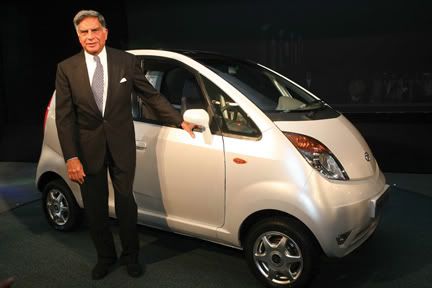
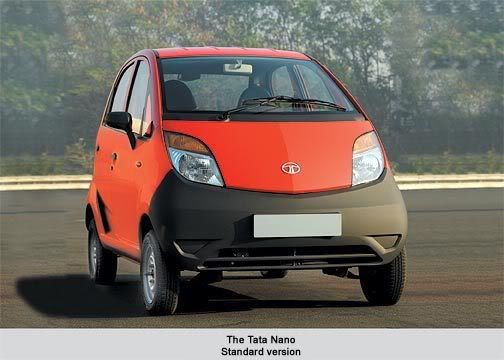
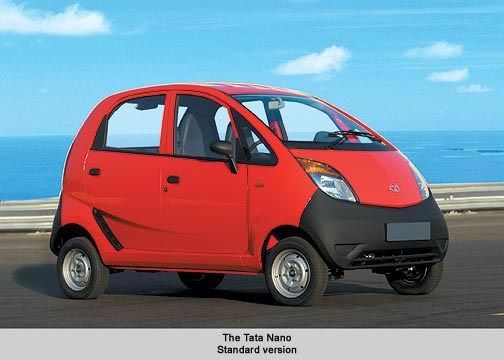
It's the car that promises to shake up the world automobile industry. The Tata Motors Nano, India's first original contribution to the car industry, was unveiled on Thursday at a packed, near-stampede launch. As promised, it's priced at Rs 1 lakh ($2,500).
The history-making car, which many industry observers predict will be a huge hit in emerging and even advanced markets, is already attracting world-wide attention with television channels in Europe and the UK telecasting the event live. Already, the launch of the Tata small car, the cheapest in the world, is being compared to seminal events such as the launch of Ford Model T and Volkswagen Beetle.
The standard variant, sans air-conditioning and power steering, will have an ex-dealer price of Rs 1 lakh. Customers will have to shell out value-added tax and logistics cost from the factory. For Delhi buyers, therefore, the standard variant is likely to cost Rs 1.20 lakh (showroom), including local levies, registration and insurance charges.
The Nano has been designed to meet offset and side impact crash test norms required overseas. In emission terms, it's Bharat Stage 3 compatible and "we can meet Euro 4 too with this engine," Mr Tata said. The car's mileage, he said, will be 20 km per litre.
The current engine is a 623 cc, two-cylinder, MPFI engine with single-balancer shaft and four-speed manual transmission. The top speed is around 105 km per hour. The power-train is packaged in the rear to increase interior space and improve manoeuvrability. Tata Motors is building a 250,000-unit plant, expandable to 350,000, at Singur that will be fulfilled before we look at satellite plants," Mr Tata said.
The company is in the process of finalising its distribution strategy for the Nano. "It won't be traditional, we will remove some layers in distribution, sales and service," Mr Tata said. "We are working on the distribution, finance and services backup for the Nano. We already have the passenger vehicle model for our Indica and other utility vehicle range that will help us to frame a structure to deliver the car," he added.
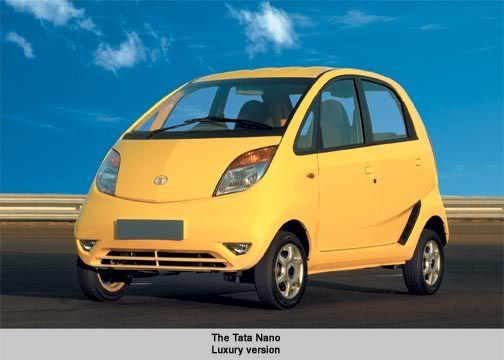
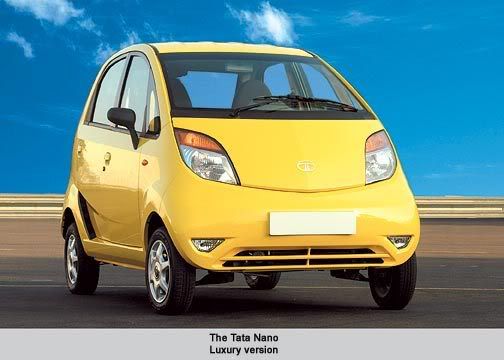
As for the price, it's not an introductory offer. "It's a promise and we will maintain the (Rs 1 lakh) price," Mr Tata said. However, the deluxe variants will carry a higher price. Given its ability to adapt to different safety and emission standards, the Nano will likely hit different global markets as well.
"For the next two-three years, our focus will be India," Mr Tata explained. "If the car is a good value proposition, it will sell well not only in India but elsewhere too, and we would like to exploit that." Once the car does vroom abroad, Tata could either go for local assembly or exports, depending on the tariff structures in those markets.
Although the Nano is an independent effort right now, "Tata Motors is working with Fiat on different issues and geographies and we will see what that leads to," Mr Tata said. The car, which was designed with inputs from the same Italian designer who worked on the Indica, uses design cues from the Tata family of vehicles.
"However, the effort was more collaborative this time and the entire design and packaging was done in India," Mr Tata said. The car, which hit headlines across the world within hours of its launch, has used several innovative engineering processes that Tata Motors has patented. The company has applied for 34 patents on aggregates, which will be leveraged across its other platforms as well. Most engine parts have been patented, including the two-cylinder petrol engine with single-balancer shaft.
The innovation drive will continue when Tata Motors moves to its satellite plant phase. "We will send painted parts to these plants as kits that can then be put together using adhesives," Mr Tata said. The company is also working on an automatic transmission, which isn't ready for unveiling yet.
Although the car is not "segment specific", Mr Tata said he hopes it will change the manner in which one travels in semi-urban and rural India. The Nano, he said, signifies Tata Motors' ability to innovate. The car has met its cost target by being a "tight efficient package".
The Nano has been hailed by both industry and government as a breakthrough product. Commerce minister Kamal Nath, who was present at the inauguration, said, "The car demonstrates to the world India's technological, intellectual and entrepreneurial abilities. It will help the common man leapfrog from two legs to four wheels, bypassing two-wheelers."
For Mr Tata, though, the toughest part is over. "The hardest part was continuing to believe we could do it," he said. "I never felt the project won't go through. I was scared I won't meet targets, price targets, time targets, the Auto Expo...Tonight, he too can rest easy.
Luxury Version


Standard Version